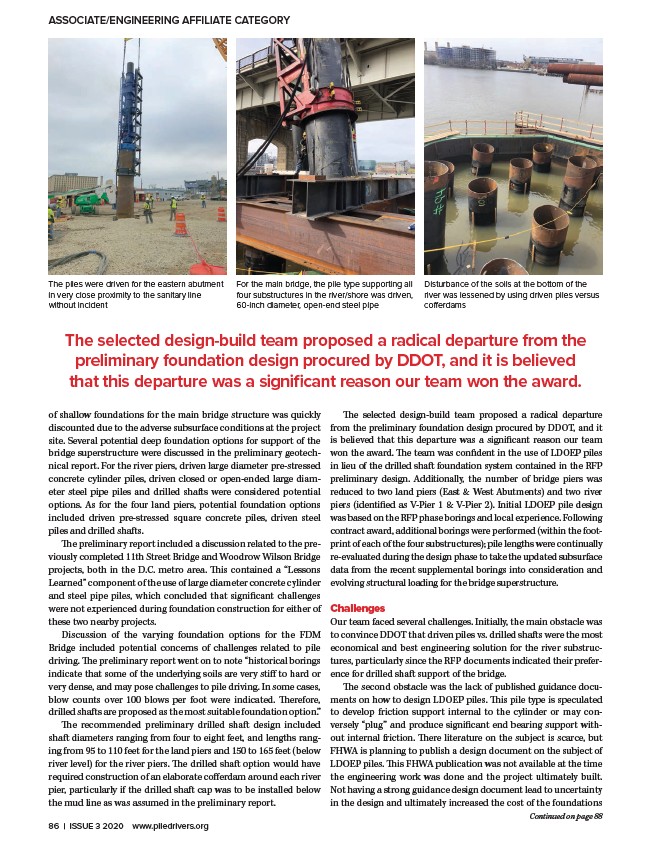
The piles were driven for the eastern abutment
in very close proximity to the sanitary line
without incident
The selected design-build team proposed a radical departure from the
of shallow foundations for the main bridge structure was quickly
discounted due to the adverse subsurface conditions at the project
site. Several potential deep foundation options for support of the
bridge superstructure were discussed in the preliminary geotechnical
report. For the river piers, driven large diameter pre-stressed
concrete cylinder piles, driven closed or open-ended large diameter
steel pipe piles and drilled shafts were considered potential
options. As for the four land piers, potential foundation options
included driven pre-stressed square concrete piles, driven steel
piles and drilled shafts.
The preliminary report included a discussion related to the previously
completed 11th Street Bridge and Woodrow Wilson Bridge
projects, both in the D.C. metro area. This contained a “Lessons
Learned” component of the use of large diameter concrete cylinder
and steel pipe piles, which concluded that significant challenges
were not experienced during foundation construction for either of
these two nearby projects.
Discussion of the varying foundation options for the FDM
Bridge included potential concerns of challenges related to pile
driving. The preliminary report went on to note “historical borings
indicate that some of the underlying soils are very stiff to hard or
very dense, and may pose challenges to pile driving. In some cases,
blow counts over 100 blows per foot were indicated. Therefore,
drilled shafts are proposed as the most suitable foundation option.”
The recommended preliminary drilled shaft design included
shaft diameters ranging from four to eight feet, and lengths ranging
from 95 to 110 feet for the land piers and 150 to 165 feet (below
river level) for the river piers. The drilled shaft option would have
required construction of an elaborate cofferdam around each river
pier, particularly if the drilled shaft cap was to be installed below
the mud line as was assumed in the preliminary report.
The selected design-build team proposed a radical departure
from the preliminary foundation design procured by DDOT, and it
is believed that this departure was a significant reason our team
won the award. The team was confident in the use of LDOEP piles
in lieu of the drilled shaft foundation system contained in the RFP
preliminary design. Additionally, the number of bridge piers was
reduced to two land piers (East & West Abutments) and two river
piers (identified as V-Pier 1 & V-Pier 2). Initial LDOEP pile design
was based on the RFP phase borings and local experience. Following
contract award, additional borings were performed (within the footprint
of each of the four substructures); pile lengths were continually
re-evaluated during the design phase to take the updated subsurface
data from the recent supplemental borings into consideration and
evolving structural loading for the bridge superstructure.
Challenges
Our team faced several challenges. Initially, the main obstacle was
to convince DDOT that driven piles vs. drilled shafts were the most
economical and best engineering solution for the river substructures,
particularly since the RFP documents indicated their preference
for drilled shaft support of the bridge.
The second obstacle was the lack of published guidance documents
on how to design LDOEP piles. This pile type is speculated
to develop friction support internal to the cylinder or may conversely
“plug” and produce significant end bearing support without
internal friction. There literature on the subject is scarce, but
FHWA is planning to publish a design document on the subject of
LDOEP piles. This FHWA publication was not available at the time
the engineering work was done and the project ultimately built.
Not having a strong guidance design document lead to uncertainty
in the design and ultimately increased the cost of the foundations
ASSOCIATE/ENGINEERING AFFILIATE CATEGORY
Disturbance of the soils at the bottom of the
river was lessened by using driven piles versus
cofferdams
For the main bridge, the pile type supporting all
four substructures in the river/shore was driven,
60-inch diameter, open-end steel pipe
preliminary foundation design procured by DDOT, and it is believed
that this departure was a significant reason our team won the award.
Continued on page 88
86 | ISSUE 3 2020 www.piledrivers.org
/www.piledrivers.org