of providing notice, to whom notice must be provided and what
must be contained in the notice. Failure to do so can lead to traps
for the unwary that can significantly weaken the ability to bring or
defend claims.
For example, the newest 2017 version of the commonly used
American Institute of Architects A201 General Conditions of the
Contract for Construction (“AIA General Conditions”) contains
just such a potential trap. This is because Article 1.6.1 of the AIA
General Conditions now provides that notice under the agreement
can be provided by electronic transmission if a method is agreed by
parties. In other words, the 2017 AIA General Conditions expressly
allows proper notice under the contract to be made by email.
However, Article 1.6.2 of the General Conditions provides
that, unlike other types of notice, Notices of Claim as provided
in Section 15.1.3 (i.e., any notice of a request for additional time
or money under the contract) must be in writing and will not be
proper unless delivered by certified or registered mail, or by courier
providing proof of delivery. In short, while email notice is acceptable
for all other types of notice under the AIA General Conditions,
an email notice of, for example, a claim for extension of time or for
additional costs due to a delay, would not be proper notice under
the 2017 AIA General Conditions, and could cause the claim to be
untimely and even potentially invalid all together.
Other key aspects to notice provisions besides just the manner
of proper notice include the timeframe within which notice must
be provided, what must be included in the notice and to whom
notice must be sent. Oftentimes, contracts will have a time period
after which the events giving rise to the claim occur in which
notice must be provided for the notice to be timely. For example,
the AIA General Conditions in Article 15.1.3.1 require that a notice
of claim must be provided “within 21 days after occurrence of the
event giving rise to such Claim or within 21 days after the claimant
first recognizes the condition giving rise to the Claim, whichever
is later.” Other contracts may potentially have even shorter timeframes,
and may also provide that a failure to timely provide notice
of the claim constitutes a waiver of the claim. Therefore, knowing
and complying with the deadlines for providing notice is crucial.
It is also important to understand and comply with what must
be included in the notice. Sometimes contracts will only require a
minimal initial notice of claim, with a more detailed and substantiated
claim to be provided by a later date. However, some contracts
require more detailed claim notice and substantiation with the initial
notice. Parties must know what is required and be prepared so
as to be able to comply if a claim situation arises. It is also critical to
know to whom notice must be provided. If the contract designates
a specific representative to whom notice must be sent, a notice
provided to someone else with that party may not ultimately be
determined to be sufficient.
Timely and compliant notice is not only important for parties
asserting claims, but can also be critical to defending claims. For
example, if a contractor is being delayed due to an event outside
of its control but fails to timely notify the owner of the delay and
request a time extension, the contractor may not able to use that
particular delay as a defense to a later claim by the owner for liquidated
damages due to a delayed completion of the project because
of the prior lack of timely notice by the contractor.
2. Failure to provide timely and proper notice can
be devastating
While the intricacies of notice provisions may seem overly technical
or unimportant, the fact is that failure to provide proper and
timely notice can be highly detrimental and even fatal to otherwise
meritorious claims. Courts in many states, including Florida, have
rejected claims entirely due to the lack of proper notice.
For example, one such case was Marriott Corp. v. Dasta
Construction Co., 26 F.3d 1057 (11th Cir. 1994), which involved a dispute
arising out of the construction of the Marriott Orlando World
Resort, which at the time was the largest hotel in Florida. The contractor,
Dasta, was substantially delayed in its work due to defective
concrete installation by another contractor hired by Marriott.
CONSTRUCTION LAW
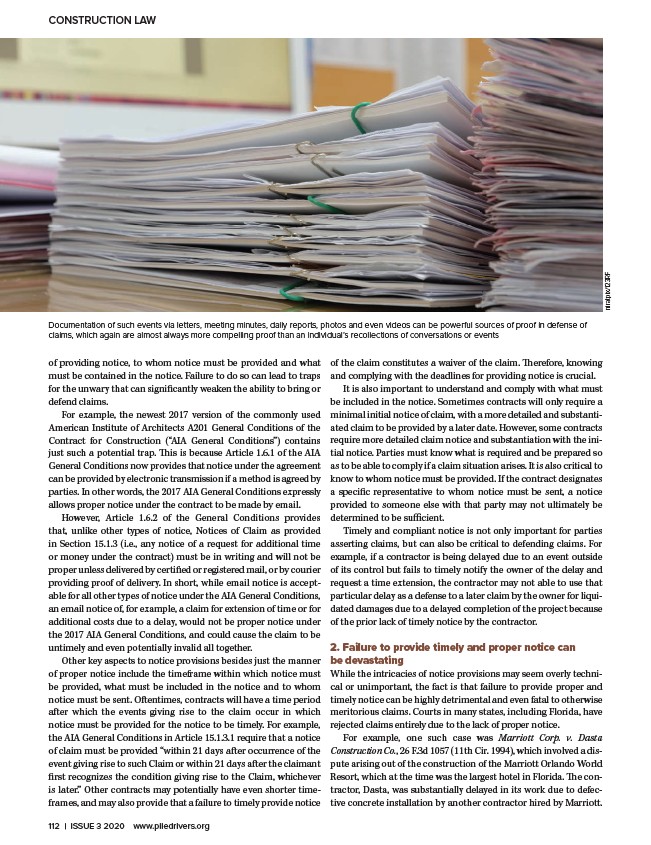
Documentation of such events via letters, meeting minutes, daily reports, photos and even videos can be powerful sources of proof in defense of
claims, which again are almost always more compelling proof than an individual’s recollections of conversations or events
niratpix/123RF
112 | ISSUE 3 2020 www.piledrivers.org
/profile_niratpix
/www.piledrivers.org