within a single pier. A typical profile consists
of interlayered sands with silts and
clays, clays, marls and soft and hard limestones.
The principal bearing layers for
end-bearing piles is in the harder limestones.
However, these harder limestone
layers are discontinuous and of varying
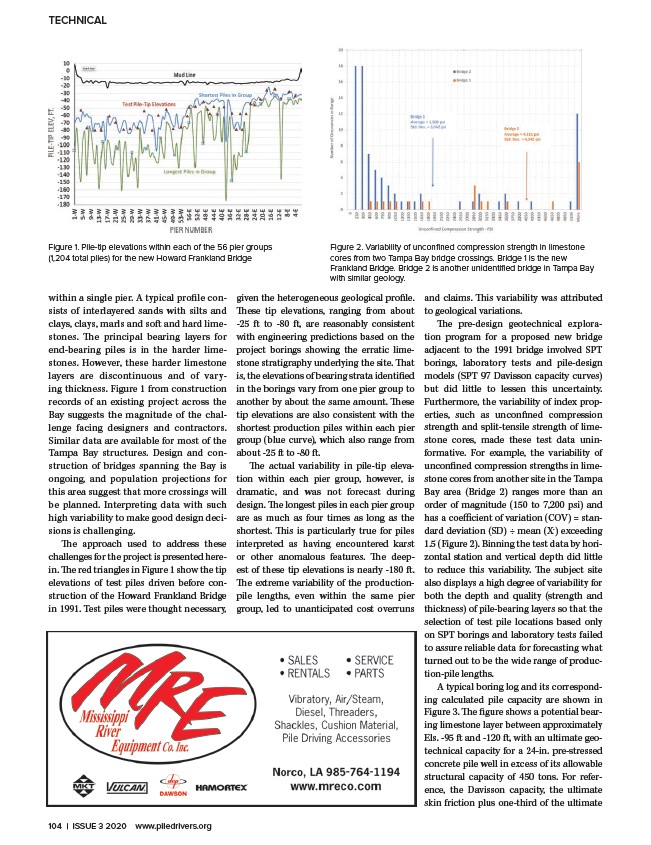
thickness. Figure 1 from construction
records of an existing project across the
Bay suggests the magnitude of the challenge
facing designers and contractors.
Similar data are available for most of the
Tampa Bay structures. Design and construction
of bridges spanning the Bay is
ongoing, and population projections for
this area suggest that more crossings will
be planned. Interpreting data with such
high variability to make good design decisions
is challenging.
The approach used to address these
challenges for the project is presented herein.
The red triangles in Figure 1 show the tip
elevations of test piles driven before construction
of the Howard Frankland Bridge
in 1991. Test piles were thought necessary,
given the heterogeneous geological profile.
These tip elevations, ranging from about
-25 ft to -80 ft, are reasonably consistent
with engineering predictions based on the
project borings showing the erratic limestone
stratigraphy underlying the site. That
is, the elevations of bearing strata identified
in the borings vary from one pier group to
another by about the same amount. These
tip elevations are also consistent with the
shortest production piles within each pier
group (blue curve), which also range from
about -25 ft to -80 ft.
The actual variability in pile-tip elevation
within each pier group, however, is
dramatic, and was not forecast during
design. The longest piles in each pier group
are as much as four times as long as the
shortest. This is particularly true for piles
interpreted as having encountered karst
or other anomalous features. The deepest
of these tip elevations is nearly -180 ft.
The extreme variability of the productionpile
lengths, even within the same pier
group, led to unanticipated cost overruns
and claims. This variability was attributed
to geological variations.
The pre-design geotechnical exploration
program for a proposed new bridge
adjacent to the 1991 bridge involved SPT
borings, laboratory tests and pile-design
models (SPT 97 Davisson capacity curves)
but did little to lessen this uncertainty.
Furthermore, the variability of index properties,
such as unconfined compression
strength and split-tensile strength of limestone
cores, made these test data uninformative.
For example, the variability of
unconfined compression strengths in limestone
cores from another site in the Tampa
Bay area (Bridge 2) ranges more than an
order of magnitude (150 to 7,200 psi) and
has a coefficient of variation (COV) = standard
deviation (SD) ÷ mean (X-) exceeding
1.5 (Figure 2). Binning the test data by horizontal
station and vertical depth did little
to reduce this variability. The subject site
also displays a high degree of variability for
both the depth and quality (strength and
thickness) of pile-bearing layers so that the
selection of test pile locations based only
on SPT borings and laboratory tests failed
to assure reliable data for forecasting what
turned out to be the wide range of production
pile lengths.
A typical boring log and its corresponding
calculated pile capacity are shown in
Figure 3. The figure shows a potential bearing
limestone layer between approximately
Els. -95 ft and -120 ft, with an ultimate geotechnical
capacity for a 24-in. pre-stressed
concrete pile well in excess of its allowable
structural capacity of 450 tons. For reference,
the Davisson capacity, the ultimate
skin friction plus one-third of the ultimate
TECHNICAL
Figure 1. Pile-tip elevations within each of the 56 pier groups
(1,204 total piles) for the new Howard Frankland Bridge
Figure 2. Variability of unconfined compression strength in limestone
cores from two Tampa Bay bridge crossings. Bridge 1 is the new
Frankland Bridge. Bridge 2 is another unidentified bridge in Tampa Bay
with similar geology.
104 | ISSUE 3 2020 www.piledrivers.org
/www.piledrivers.org
/