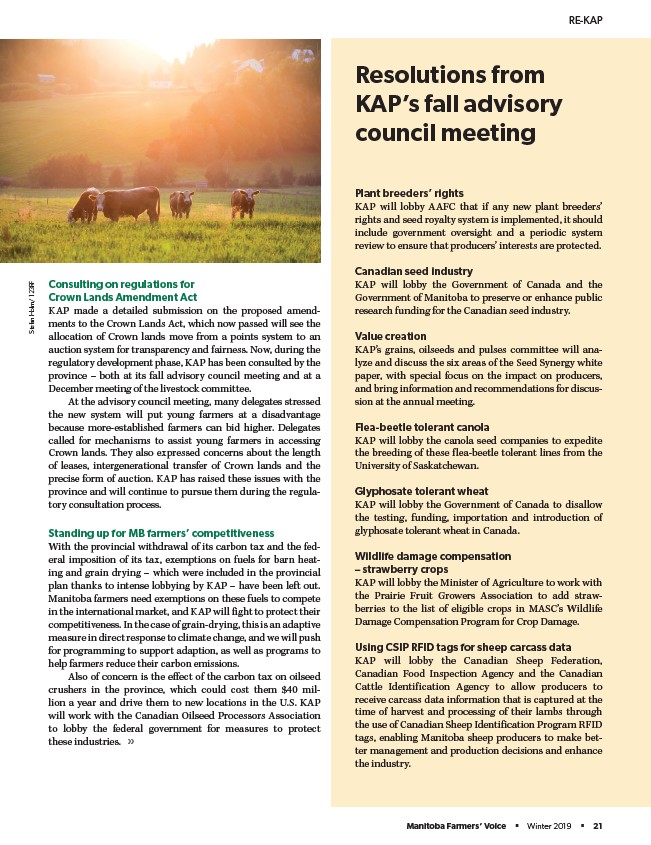
Stefan Holm/ 123RF
Consulting on regulations for
Crown Lands Amendment Act
KAP made a detailed submission on the proposed amendments
to the Crown Lands Act, which now passed will see the
allocation of Crown lands move from a points system to an
auction system for transparency and fairness. Now, during the
regulatory development phase, KAP has been consulted by the
province – both at its fall advisory council meeting and at a
December meeting of the livestock committee.
At the advisory council meeting, many delegates stressed
the new system will put young farmers at a disadvantage
because more-established farmers can bid higher. Delegates
called for mechanisms to assist young farmers in accessing
Crown lands. They also expressed concerns about the length
of leases, intergenerational transfer of Crown lands and the
precise form of auction. KAP has raised these issues with the
province and will continue to pursue them during the regulatory
consultation process.
Standing up for MB farmers’ competitiveness
With the provincial withdrawal of its carbon tax and the federal
imposition of its tax, exemptions on fuels for barn heating
and grain drying – which were included in the provincial
plan thanks to intense lobbying by KAP – have been left out.
Manitoba farmers need exemptions on these fuels to compete
in the international market, and KAP will fight to protect their
competitiveness. In the case of grain-drying, this is an adaptive
measure in direct response to climate change, and we will push
for programming to support adaption, as well as programs to
help farmers reduce their carbon emissions.
Also of concern is the effect of the carbon tax on oilseed
crushers in the province, which could cost them $40 million
a year and drive them to new locations in the U.S. KAP
will work with the Canadian Oilseed Processors Association
to lobby the federal government for measures to protect
these industries.
Resolutions from
KAP’s fall advisory
council meeting
Plant breeders’ rights
KAP will lobby AAFC that if any new plant breeders’
rights and seed royalty system is implemented, it should
include government oversight and a periodic system
review to ensure that producers’ interests are protected.
Canadian seed industry
KAP will lobby the Government of Canada and the
Government of Manitoba to preserve or enhance public
research funding for the Canadian seed industry.
Value creation
KAP’s grains, oilseeds and pulses committee will analyze
and discuss the six areas of the Seed Synergy white
paper, with special focus on the impact on producers,
and bring information and recommendations for discussion
at the annual meeting.
Flea-beetle tolerant canola
KAP will lobby the canola seed companies to expedite
the breeding of these flea-beetle tolerant lines from the
University of Saskatchewan.
Glyphosate tolerant wheat
KAP will lobby the Government of Canada to disallow
the testing, funding, importation and introduction of
glyphosate tolerant wheat in Canada.
Wildlife damage compensation
– strawberry crops
KAP will lobby the Minister of Agriculture to work with
the Prairie Fruit Growers Association to add strawberries
to the list of eligible crops in MASC’s Wildlife
Damage Compensation Program for Crop Damage.
Using CSIP RFID tags for sheep carcass data
KAP will lobby the Canadian Sheep Federation,
Canadian Food Inspection Agency and the Canadian
Cattle Identification Agency to allow producers to
receive carcass data information that is captured at the
time of harvest and processing of their lambs through
the use of Canadian Sheep Identification Program RFID
tags, enabling Manitoba sheep producers to make better
management and production decisions and enhance
the industry.
RE-KAP
❯❯
Manitoba Farmers’ Voice § Winter 2019 § 21