Group Insurance for Farm Owners and Employees
Ensure you and your employees are properly covered
Optional Life
Insurance Plan
(annual rates per
$25,000 unit)
Non-Smoker Smoker
Age Male Female Male Female
Under 30 $12.67 $10.56 $21.12 $16.90
30-39 $14.78 $12.80 $29.30 $25.34
40-44 $24.42 $19.14 $54.91 $42.11
45-49 $48.84 $30.36 $99.00 $72.60
50-54 $90.42 $52.80 $173.18 $119.46
55-59 $138.60 $87.65 $289.74 $177.54
60-64 $214.76 $151.93 $392.04 $247.50
65-69 $370.52 $262.68 $675.84 $425.70
Administered by:
For more
information
Call the KAP Benefits line at
1-866-KAP-0123
(1-866-527-0123)
or email:
kapbenefits@hubinternational.com
OPTIONAL LIFE INSURANCE
• Available in units of $25,000 up to $500,000 (minimum of $50,000)
• Includes a living benefit that pays 25% of the insurance coverage to a
maximum of $50,000 if the insured is diagnosed with a terminal illness
• Coverage to age 70 (must enrol prior to age 60)
• Approval of a medical questionnaire is required
GROUP INSURANCE RATES
ALSO AVAILABLE FOR
• Critical Illness
• Accident Insurance
• Health and Dental
Canada has three new international trade agreements
coming into force at roughly the same time.
The Comprehensive Economic and Trade Agreement
(CETA) with the European Union has been in force provisionally
since September 2017, although it still must be ratified by
each EU member and the European Parliament.
The recently negotiated United States-Mexico-Canada
agreement (USMCA) replaces the former North American Free
Trade Agreement.
Ottawa recently passed legislation ratifying Canada’s
participation in the 11-nation Comprehensive and
Progressive Trans-Pacific Partnership (CPTPP), which will
reduce tariffs and open new markets in Asia and other
Pacific Rim countries.
“The value of the trade agreements like CETA, USMCA,
and CPTPP directly increases incomes for all parts of the value
chain, including farmers, while supporting jobs and economic
growth,” said Brenna Mahoney, director of communications
and stakeholder relations with Cereals Canada.
“To put this in perspective, 90 per cent of all Canadian
farms rely on exports, one in two jobs in crop production
depend on exports and one in four jobs in food manufacturing.”
A number of Canada’s commodity groups are already
enthusiastic about these agreements, predicting major
increases in certain agricultural exports.
“Global Affairs suggests the CPTPP will create extra
(pork) sales of $639 million in Japan alone. Canadian pork
producers are looking forward to that,” said Rick Bergmann,
who raises hogs near Steinbach and chairs the Canadian
Pork Council.
Bergmann said ratifying CPTPP will also help producers
recover from sharply depressed markets resulting from
retaliatory tariffs by China and Mexico on U.S. pork earlier
this year.
“The U.S. trade problems with other countries affected
us because we price off the U.S. formula,” he said. “Canadian
pork producers will benefit from immediate tariff reductions
on fresh chilled pork and projected savings of $51 million
are expected.”
Bonnett said Canada has another advantage in Japan
because President Donald Trump pulled the U.S. out of CPTPP
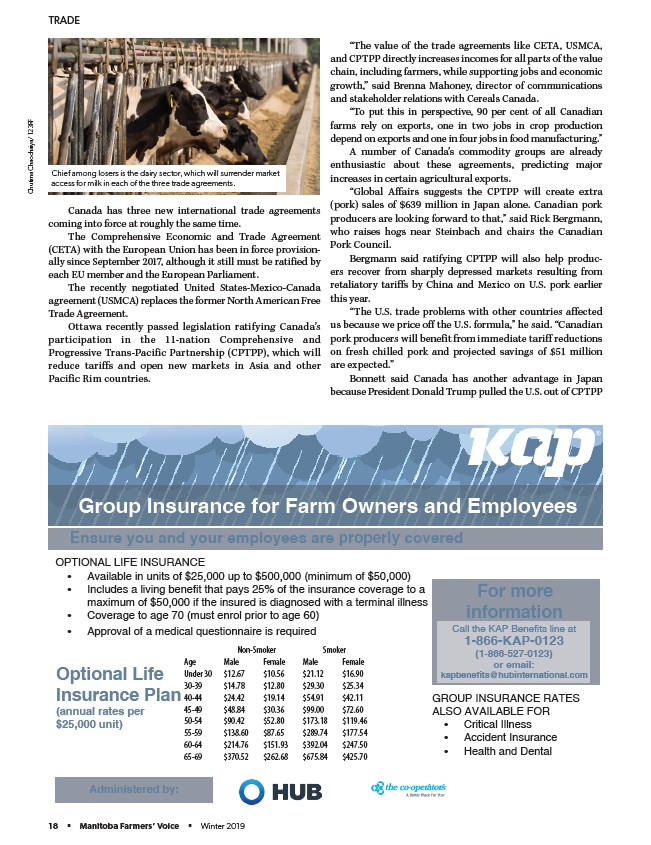
Chief among losers is the dairy sector, which will surrender market
access for milk in each of the three trade agreements.
Chutima Chaochaiya/ 123RF
TRADE
18 § Manitoba Farmers’ Voice § Winter 2019
link
link