in one of his first official acts after assuming the presidency in
January 2017.
“If we can get in and build a customer base in Japan, that
gives us quite a leg up on the U.S. from a competitive point of
view,” said Bonnett.
But others sound a cautionary note, saying trade agreements
don’t necessarily mean a quantum increase in exports
right away.
For example, CETA provides for a total of 50,000 tonnes
of duty-free beef imports phased in over six years. So far, however,
Canada’s beef exports to the EU are miniscule, totalling
less than 500 tonnes in 2017, according to Statistics Canada.
The reason is that Europe requires beef to be raised without
hormone implants and carcasses not to be sprayed with
acid washes to reduce bacterial pathogens – both common
procedures here.
So far, only a few Canadian packing plants are registered
to ship beef to the EU because of the extra effort and expense
needed to meet European requirements.
“The market is potentially large. It’s just that the
obstacles we face are limiting the growth,” said Mark
Klassen, director of technical services with the Canadian
Cattlemen’s Association.
That’s the kind of problem Buckingham has in mind when
he says getting rid of tariffs is the easy part but eliminating
non-tariff barriers is much harder.
“The next steps are really hard work where we have to
start looking at some of the technical barriers that are still
remaining and slowing us down,” he said. “The technical barriers
that will allow a freer flow of both inputs and products
will be the next frontier.”
But while nations undertake free trade negotiations with
hopes of gains for both sides, that doesn’t necessarily mean a
benefit for everyone.
That’s especially true for Canada’s supply management
system, which has had to give up market access as a trade-off
for gains in other sectors.
Chief among losers is the dairy sector, which will
surrender market access for milk in each of the three
trade agreements.
According to Dairy Farmers of Canada, the market access
granted in USMCA amounts to 3.9 per cent of Canada’s milk
production in 2017, valued at $192 million a year. The access is
1.5 per cent under CETA and 3.25 per cent under CPTPP.
DFC estimates that, once these agreements are fully
implemented in 2024, Canada will import roughly 18 per cent
of its milk production, representing a loss of $1.3 billion in
farm gate sales for Canadian dairy producers.
In addition, the dairy sector faces the loss of Class 7, a
new milk class created last year to price milk ingredients such
as protein contents lower in order to compete against U.S.
imports. DFC says removing Class 7, along with a surcharge
on exports, could cost producers up to another $350 million
per year.
All of this reflects the hard reality behind trade negotiations
in which not everybody comes out ahead, says
Buckingham.
“On a macro level, countries need some sense of win-win
before going into these agreements. But on a micro level, there
will always be winners and losers in different sectors or even
the same sector.” FV
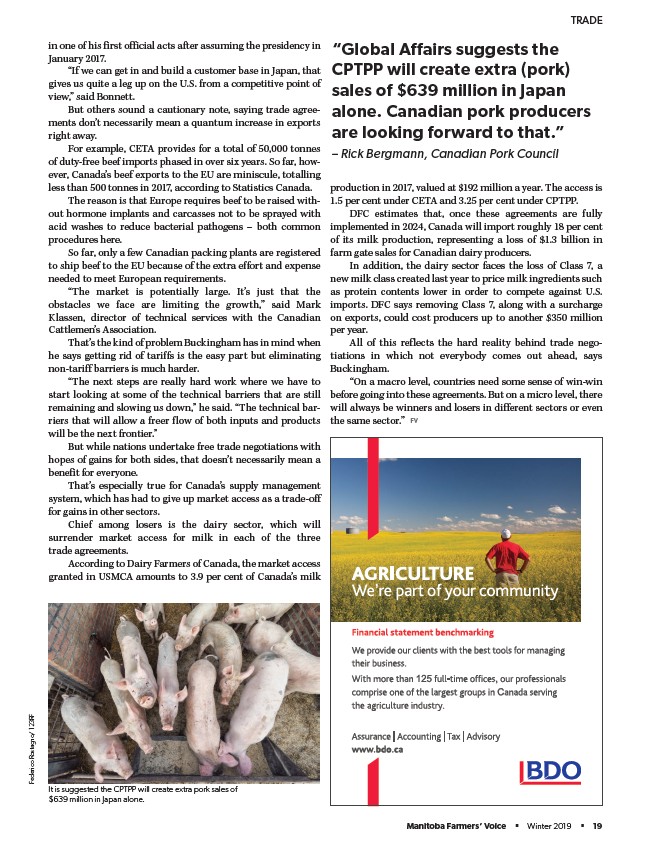
It is suggested the CPTPP will create extra pork sales of
$639 million in Japan alone.
“Global Affairs suggests the
CPTPP will create extra (pork)
sales of $639 million in Japan
alone. Canadian pork producers
are looking forward to that.”
– Rick Bergmann, Canadian Pork Council
Federico Rostagno/ 123RF
TRADE
Manitoba Farmers’ Voice § Winter 2019 § 19
/www.bdo.ca