WATER MANAGEMENT
Producers are more than willing to
participate with conservation groups,
he said, because they see the benefits of
those programs on their own farms. But
striking a balance between sustainability
and productivity is key.
“We are stewards of the land and
have been for centuries,” said Campbell.
“We are really concerned about soil
health – without the soil you don’t make
a living. You can have all of those principles,
but if you can’t pay your bills, they
don’t matter.”
Another problem on Campbell’s
radar is monetization of unreserved
wetlands, requiring producers now to
pay to drain them.
“That has caused some concern
because now that we have determined
the value of some of these wetlands,
the government wants producers to
pay to drain land that they already
own,” said Campbell.
Campbell proposes implementing
a type of ecological goods and services
type of program to allow farmers to generate
some income from their wetland.
“If society believes that these
retained wetlands are significant
enough to have a value, they should pay
the landowner the money, and he will
leave it,” he explained. “That’s where it
gets complicated. Is the rain that falls
on my land that drains into a slough
my water? I didn’t own it until it hit my
ground. The lakes would not benefit if
farmers were to keep all their water. So
pay me to send the water downstream,
if others want it.”
Campbell himself owns wetland so
he knows firsthand the frustration of
having to pay for land he cannot use.
“If I have to take a 10-to-20 per cent
hit on my land revenue because of water
management regulations, who’s paying
me? There’s the brunt of it,” said
Campbell. “If society is willing to contribute
to a water management plan,
then agriculture will be involved and is
part of the process.”
The bigger conversation, said
Campbell, is about ownership.
“Producers essentially believe that
when they’re farming, they own their
land,” he explained. We control what
we sow on it, when we harvest it. We
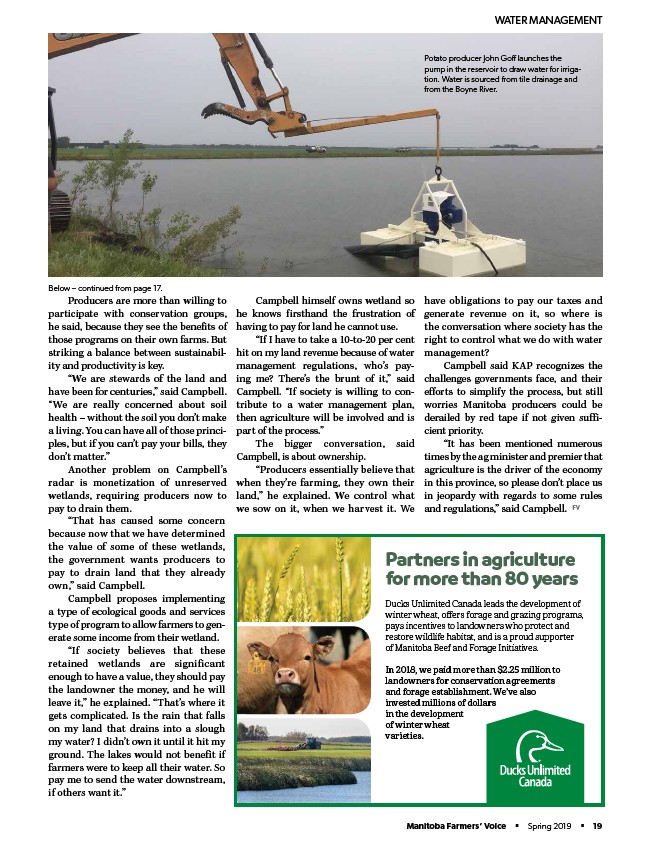
Potato producer John Goff launches the
pump in the reservoir to draw water for irrigation.
Water is sourced from tile drainage and
from the Boyne River.
have obligations to pay our taxes and
generate revenue on it, so where is
the conversation where society has the
right to control what we do with water
management?
Campbell said KAP recognizes the
challenges governments face, and their
efforts to simplify the process, but still
worries Manitoba producers could be
derailed by red tape if not given sufficient
priority.
“It has been mentioned numerous
times by the ag minister and premier that
agriculture is the driver of the economy
in this province, so please don’t place us
in jeopardy with regards to some rules
and regulations,” said Campbell. FV
Partners in agriculture
for more than 80 years
Ducks Unlimited Canada leads the development of
winter wheat, offers forage and grazing programs,
pays incentives to landowners who protect and
restore wildlife habitat, and is a proud supporter
of Manitoba Beef and Forage Initiatives.
In 2018, we paid more than $2.25 million to
landowners for conservation agreements
and forage establishment. We’ve also
invested millions of dollars
in the development
of winter wheat
varieties.
Below – continued from page 17.
Manitoba Farmers’ Voice § Spring 2019 § 19