WATER MANAGEMENT
125 years. 15,000 farms. One promise.
To produce Canada Grade A coverage and claims service.
From acreages to hobby farms and full-scale agri-food businesses, Canadian farm families
look to Portage Mutual for the best in agricultural property insurance. Ask your broker about
the Agricultural Pro from Portage Mutual.
R e s i d e n t i a l - C o m m e r c i a l - A u t o m o b i l e - F a r m
www.portagemutual.com
The act states Class 1 land will have no significant limitations
in terms of crop viability and conservation practices,
while Class 2 land is deemed moderately limited, or requires
only moderate conservation practices. Class 3 categorizes
land as having moderately severe limitations – meaning the
range of crops is restricted or requires special conservation
practices. Class 4 land limitations are deemed severe, while
Class 5 land is only feasible for forage crop improvement practices.
Class 6 land is designated unfeasible for any forage crop
improvements.
For a $100 application fee, Class 1 and 2 landowners will
be able to implement water mitigation strategies up to a foot
deep, Campbell explained. A more structured water management
permit will be available for lands designated Class 3, 4 or
5, for a $500 fee.
The problem, Campbell said, is determining which lands
would receive Class 3 designation.
“That’s a bit of a grey area,” he said.
Campbell would like to see water management on land
classified 3 and 4 allowing amalgamation of excess water to a
central retention area, thereby creating an enhanced wetland
surrounded by forages. The water would be reserved for irrigation
to be used later in the growing season.
“Then you can surface irrigate or pump the water back
up the tile (drainage system), which would help with drought
mitigation – because you’re putting water back into the root
system,” Campbell explained.
He said this technique is already being used in Canada
and other parts of North America.
“This isn’t new,” said Campbell. “I think it’s only forward
thinking, but we don’t need rules and regulations that impede
us from doing that particular water management. Controlling
moisture is what makes land productive. You can get excess
water in the Red River Valley but in five days it’s gone. Around
here (southwest Manitoba), if we get excess water we can keep
it for a long time.”
Campbell said the amalgamation technique would also
benefit the government by reducing dependency on crop
insurance.
“If you can control the water on your land, there won’t be
as many flood or drought claims, and production will go up. It
enhances everything.”
According to Campbell, water amalgamation would also
increase the efficiency of modern-day agricultural equipment,
and would result in less fuel waste, as well as fewer chemical,
fertilizer and seed applications.
Water management infrastructure would also help
municipalities mitigate their own flood damage.
“If you look at some of the problems we’ve had with floods
in 2011 and 2016, our road infrastructure (damage) took place
where water was not managed properly,” said Campbell.
“They’ve had to spend tremendous amounts of money when
we could have utilized that water in other areas.”
Campbell said significant increases in land assessment
values have added to producers’ woes, especially without
water management controls, because they aren’t able to
generate revenue but are still on the hook to pay increased
property taxes.
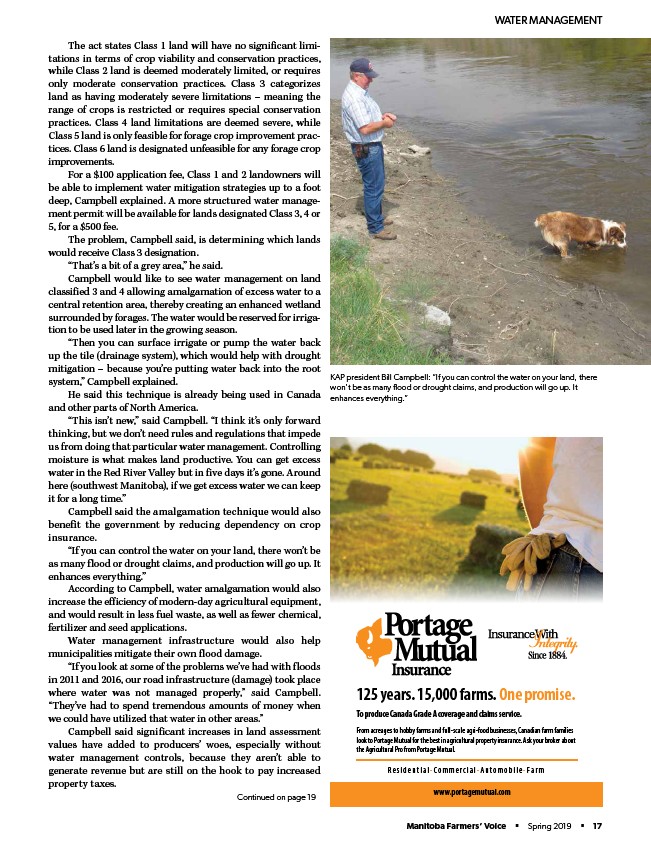
KAP president Bill Campbell: “If you can control the water on your land, there
won’t be as many flood or drought claims, and production will go up. It
enhances everything.”
Continued on page 19
Manitoba Farmers’ Voice § Spring 2019 § 17
/www.portagemutual.com