feature
What is soil relaxation?
Soil setup typically occurs due to an
increase in positive pore water pressure
(+pwp) resulting in a decrease in effective
soil stress during driving. This temporarily
lowers the soil resistance during driving.
Over varying degrees of time after
pile installation, based on soil types, the
pore water pressure dissipates resulting in
an increase of soil strength and higher pile
capacity over time.
Soil Set-up (Pile Capacity Increase):
σ‘ = σT – (+pwp)
(lowered effective stress during driving)
Soil relaxation typically occurs in
dense sands, inorganic sandy silt, stiff fissured
clay and weathered bedrock formation,
especially shale. With these soil types
and certain conditions, rather than get a
temporary reduction in the effective stress
of the soils during driving, soil relaxation
occurs due to a temporary increase in the
soil effective stress during driving. This is
due to the increase of negative pore water
pressure (-pwp) due to soil dilation caused
by soil particle over-ride. The groundwater
may not infiltrate the tight particle structure
sufficiently fast enough to equalize the
pore water pressure resulting in a decrease
in pwp for a short time. The end result is
a temporary increase in the effective stress
of the soil, harder driving and temporary
capacity, which will later be reduced.
Soil Relaxation (Pile Capacity Decrease):
σ‘ = σT – (-pwp)
σ‘ = σT + pwp
(increased effective stress during driving)
How much capacity reduction can
occur?
Every time we thought we had figured out
how to predict when and to what degree
soil relaxation would occur, things would
change on us again. The degree of soil
relaxation resulted in capacity reductions
ranging from 25 to 65 percent. This was
learned through quite a bit of trial and
error. The main lesson learned for us
was to assure that the production piles
were installed to a similar tip elevation
as the test pile, which was initially evaluated
for soil relaxation by performing
multiple PDA set-checks over time. This
was accomplished by including provisions
in the production pile driving criteria that
specified minimum tip elevations that
were consistent with the test pile.
We also learned there were several
conditions contributing to the observed soil
relaxation. The primary factor was the soil
conditions, which included a shallow, dense
sand layer where the piles were bearing.
The piles had relatively minimal penetration
(less than 50 feet) and were terminated
in dense sand with low fines material (passing
the No. 200 sieve) content. Also, the
square concrete piles were designed to carry
near their maximum capacity of around
900 kips. The installation methods did not
include any predrilling to loosen the dense
feature
soils, and the driving hammer was a diesel
hammer using a high stroke height.
So in summary, the common conditions
where soil relaxation was observed for
various projects in our area included:
•• Soil relaxation in conditions with relatively
high required pile capacities
(greater than 500 kips)
•• Referenced soil conditions such as very
dense sands
•• Relatively limited amount of pile penetration
(less than 50 feet). These have
been the conditions for soil relaxation
for various projects in our area.
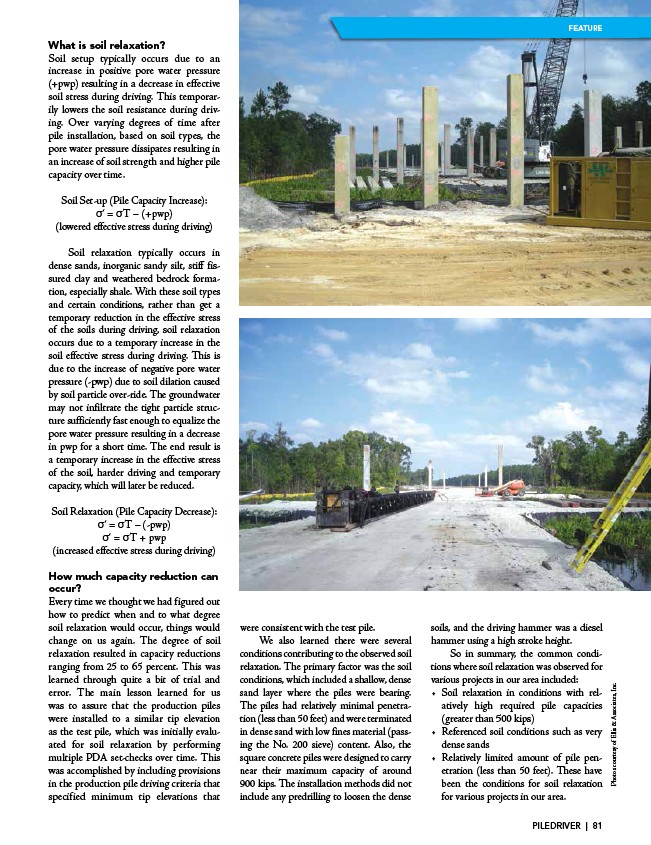
Photos courtesy of Ellis & Associates, Inc.
PILEDRIVER | 81