feature
ists and verified piles capacities by multiple
PDA specialists per foundation unit. The
required independent VT PDA checks
resulted in determining time-dependent
capacities in conditions that were not previously
thought to be ideal for soil-setup.
First encounter with soil
relaxation
We first encountered soil relaxation and
pile capacity reduction while providing the
PDA services for the contractor on our first
design-build project. It was an important
project for us – our largest project during
an era when projects were scarce. We were
familiar with the project area as we had
performed soil borings, initial geotechnical
services and had provided PDA services
on similar projects in the area. We learned
about soil relaxation on the first foundation
unit, which included the first few piles of
hundreds of planned piles and thousands
of feet of precast prestressed concrete piles
to be installed. We were blissfully unaware
of the possibility for soil relaxation. Soil
relaxation was not even a part of our
vocabulary!
Life was good. Everything was going
as planned. We performed traditional
PDA services, determined production
pile lengths, issued pile driving criteria,
observed the installation of the production
piles and finally certified that the
foundation met the contract documents.
Then came the VT PDA testing and the
independent VT PDA consultant tested
selected piles. The results? Rejected. The
foundation was rejected because the piles
did not achieve the required pile capacity.
How could this happen? What was
going on? We had PDA data showing the
test pile had plenty of pile capacity and
our driving criteria were based on a reliable
CAPWAP and WEAP analysis. We
feature
thought, “This could not be happening,
there must be something wrong with the
VT PDA data.”
As much as we wished that the VT
PDA data was somehow not accurate, it
was hard to ignore an obvious problem.
The blow counts observed during the VT
set-check were much lower compared to
the blow counts observed at the end of the
initial drive. It could not be ignored; the
piles had decreased in capacity. But how
much? What could be causing this? Did we
make a mistake? What could we do? What
if we have to splice all these piles? Would
the piles continue to decrease in capacity?
Life was not good. We had a lot of
questions, no answers, hundreds of piles
to go, a client who needed to keep moving
and a project owner asking why we certified
failing piles. Living with a soil relaxation
problem is no fun.
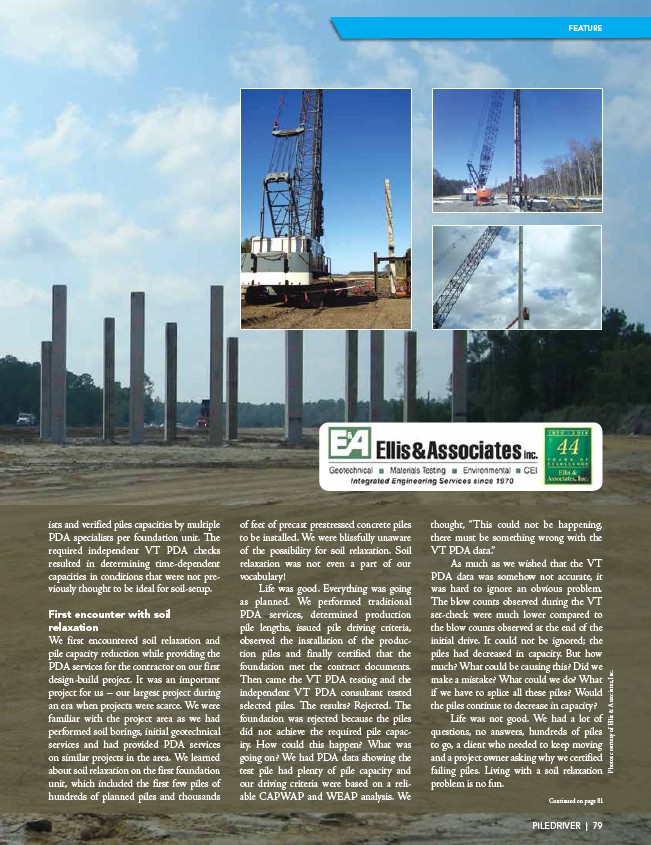
Photos courtesy of Ellis & Associates, Inc.
Continued on page 81
PILEDRIVER | 79