strands typically used in a 24-inch-square
pile. Another reason to increase the number
of strands by four was to keep the strand
pattern symmetrical. It should be noted
that the LaDOTD design for the piles was
based on a 240 ksi ultimate strength for
the stainless steel strands, which was lower
than the 250 ksi for the strands that were
used. To obtain the LaDOTD-specified
prestressing force, the strand was stressed
to a fraction slightly less than 70 percent of
the tensile strength.
Strand was not the only item in the
concrete piles that was stainless steel.
LaDOTD specified that the W4.5 wire
spirals be Type 304 or 316 annealed stainless
steel. The tie wire, the strand used for
lift loops, and the reinforcing bar template
that GCP uses to ensure strand placement
in the middle of the long piles, were also
required to be stainless steel.
In 2016, LaDOTD introduced performance
based concrete specifications1
that included low-permeability concrete
mixtures. GCP had already received
approval for a six-ksi concrete mixture
with a minimum surface resistivity of 22
kohm-cm at 28 days. The concrete mixture
did not require any modifications because
of the stainless steel strand.
Long lead times for materials
Stainless steel strand is not a stock item,
especially when domestically produced
strand is required, as on this project.
Currently, suppliers only produce the
strand when a sufficient number of orders
have been placed to warrant production.
Sumiden Wire was willing to guarantee
delivery within six months for the 0.5-inchdiameter
stainless steel strand, which is produced
in its Dickson, Tenn. facility. Lead
times for the stainless wire for the spirals
and preformed tie wire were six and two
weeks, respectively.
Production
In November 2017, GCP cast the 78-footlong,
24-inch-square prestressed concrete
piles. In the typical production cycle, four
piles were cast in each of two adjacent
420-foot-long casting beds, for a total of
eight piles. The use of the stainless steel
CONCRETE
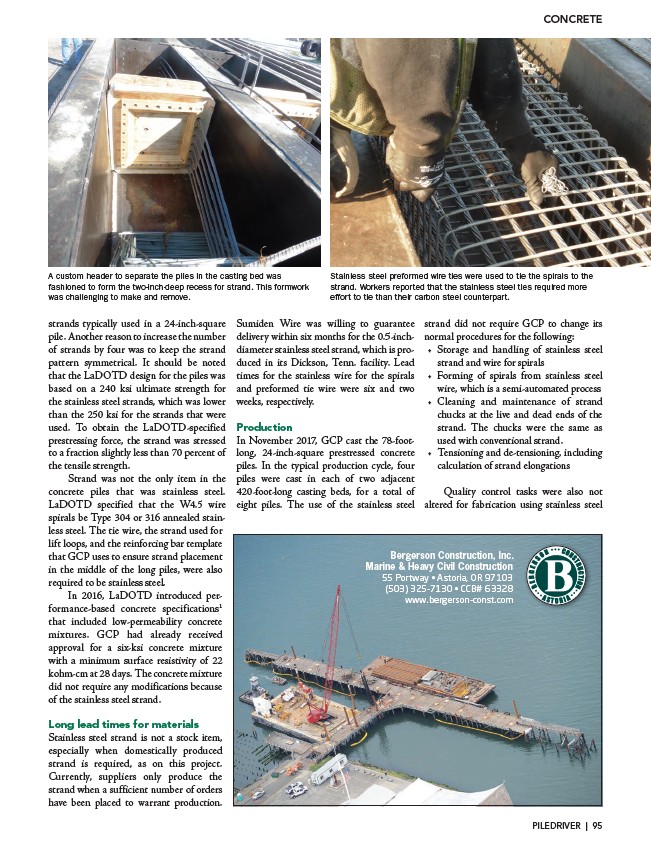
A custom header to separate the piles in the casting bed was
fashioned to form the two-inch-deep recess for strand. This formwork
was challenging to make and remove.
Stainless steel preformed wire ties were used to tie the spirals to the
strand. Workers reported that the stainless steel ties required more
effort to tie than their carbon steel counterpart.
strand did not require GCP to change its
normal procedures for the following:
•• Storage and handling of stainless steel
strand and wire for spirals
•• Forming of spirals from stainless steel
wire, which is a semi-automated process
•• Cleaning and maintenance of strand
chucks at the live and dead ends of the
strand. The chucks were the same as
used with conventional strand.
•• Tensioning and de-tensioning, including
calculation of strand elongations
Quality control tasks were also not
altered for fabrication using stainless steel
Bergerson Construction, Inc.
Marine & Heavy Civil Construction
55 Portway • Astoria, OR 97103
(503) 325-7130 • CCB# 63328
www.bergerson-const.com
PILEDRIVER | 95
/www.bergerson-const.com
/www.bergerson-const.com