Although stainless steel strand is
not a new technology, it has rarely
been used for precast, prestressed
concrete components in transportation
structures. There are rumors and misconceptions
about special requirements and
equipment needed for its incorporation into
the prestressed concrete fabrication process.
This article focuses on the production process
of full-size prestressed concrete piles
using stainless steel strand and addresses
designing prestressed concrete components
using stainless steel strand.
Background
According to Mark Bucci, bridge design
manager at the Louisiana Department
of Transportation and Development
(LaDOTD), the use of non-carbon steel
strand in the precast, prestressed concrete
piles on one of three bridges on the Bayou
Thunder Overflow Project is an effort to
increase the service life of the structure
from 50 to 100 years. Corrosion-resistant
strand (stainless steel or carbon fiber reinforced
polymer) was specified for the fortytwo
24-in.-square, 78-foot-long prestressed
concrete piles on one of the three bridges of
the project. Low-permeability concrete was
used in these piles to limit saltwater and
chloride intrusion and new detailing for
the pile tip and head was also incorporated.
The cost of the piles with the stainless steel
strands and other detailing measures to
increase service life was more than 200 percent
higher than that of piles using conventional
carbon steel strands. The result was a
$590,000 increase to the cost of the project.
Gulf Coast Pre-Stress (GCP) in Pass
Christian, Miss., bid the project based on
the stainless steel option and was awarded
the contract to produce the piles. GCP then
began the journey to fabricate the first prestressed
concrete piles using stainless steel
strand to be used in an LaDOTD structure.
Materials
For the project, LaDOTD specified that
the seven-wire, 0.5-inch-diameter stainless
steel strand meet the chemical require-
CONCRETE
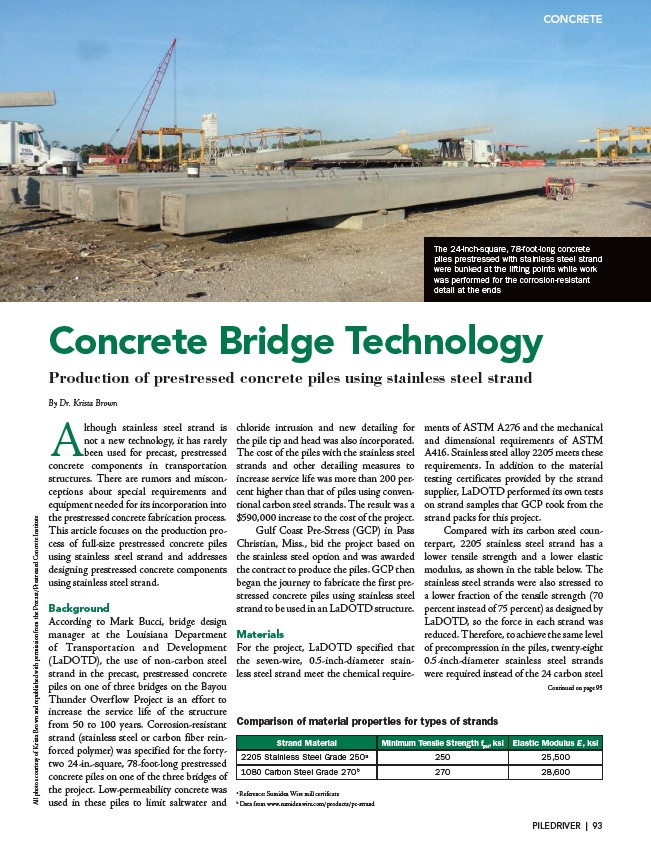
The 24-inch-square, 78-foot-long concrete
piles prestressed with stainless steel strand
were bunked at the lifting points while work
was performed for the corrosion-resistant
detail at the ends
Concrete Bridge Technology
Production of prestressed concrete piles using stainless steel strand
By Dr. Krista Brown
Comparison of material properties for types of strands
Strand Material Minimum Tensile Strength fpu, ksi Elastic Modulus E, ksi
2205 Stainless Steel Grade 250a 250 25,500
1080 Carbon Steel Grade 270b 270 28,600
a Reference: Sumiden Wire mill certificate
b Data from www.sumidenwire.com/products/pc-strand
All photos courtesy of Krista Brown and republished with permission from the Precast/Prestressed Concrete Institute
ments of ASTM A276 and the mechanical
and dimensional requirements of ASTM
A416. Stainless steel alloy 2205 meets these
requirements. In addition to the material
testing certificates provided by the strand
supplier, LaDOTD performed its own tests
on strand samples that GCP took from the
strand packs for this project.
Compared with its carbon steel counterpart,
2205 stainless steel strand has a
lower tensile strength and a lower elastic
modulus, as shown in the table below. The
stainless steel strands were also stressed to
a lower fraction of the tensile strength (70
percent instead of 75 percent) as designed by
LaDOTD, so the force in each strand was
reduced. Therefore, to achieve the same level
of precompression in the piles, twenty-eight
0.5-inch-diameter stainless steel strands
were required instead of the 24 carbon steel
Continued on page 95
PILEDRIVER | 93
/pc-strand
/pc-strand