PDCA CONTRACTS & RISK COMMITTEE
is the source of the money on the project. Even so, the transfer of
risk can backfire if the owner misevaluated the capacity of the general
contractor to manage the risk.
For example, the owner can transfer the risk of delays by
denying any compensation to the general contractor for ownergenerated
delays. That does not mean that the owner can abuse this
transfer by neglecting their other obligations under the contract
that may result in delays, or if the owner has superior knowledge
that the delays are going to happen at a rate uncommon with the
scope of the project. In these circumstances, with all the contractual
transfer of the risk of delays, the owner may still be ordered by the
courts to compensate the general contractor for delays. This is true
in some states even if a no damages for delay clause or other risk
shifting mechanism is included in the contract.
A second often-missed risk for the owner is if the general
contractor cannot manage the risk and delays materialize on the
project that cause the owner to suffer significant financial losses not
fully compensated by the penalties payed by the general contractor
and its sureties. This is a very good incentive for the owner to continue
to actively manage the risk even if it is transferred.
If the risk transferor has a lower position in the project delivery
chain (the pile subcontractor) than the transferee (the general contractor),
there is a larger residual risk left with the transferor, primarily
because the transferee is the purse holder and could find comfort in
the prime contract to attenuate the consequences of the accepted risk.
To exemplify, consider a case of a pile subcontractor that took
exception to obstructions in its contract with a general contractor.
It goes beyond excluding the obstructions from its scope of work
and agrees with the general contractor for unit prices for the time
lost and extra piles to replace any obstructed piles, etc. The pile
subcontractor is confident that in case of encountering an obstruction,
they will be properly compensated as detailed in the contract.
Unfortunately, they do not monitor the risk and do not realize
that the amount of obstructions encountered on the construction
site could be considered in excess of what it is considered normal
occurrence by industry standard, and therefore, constitutes a Type
II differing site condition.
The shock to the pile subcontractor then comes at the end
of the job when the they invoice the value of its obstruction work
and are denied payment. The general contractor argues that the
frequency of obstructions was due to different site conditions.
Therefore, a pass-through claim has to be sent to the owner. In
this moment, the pile subcontractor’s ability to be paid for its
obstruction work is dependent on a likely self-serving decision
made by the owner under the prime contract. The owner will
most likely deny the claim and the pile subcontractor’s only option
to get a payment is to spend years litigating a claim. What an
unexpected reversal of fortune for the subcontractor!
Given that the subcontractor thought that it did not have any
payment risk associated with the obstruction work, it likely did not
monitor and document the seemingly precluded risk properly in the
manner that it would have monitored a known differing site condition.
Under such circumstances, the pile subcontractor will likely
not be fully prepared to advocate its position in court with optimal
supporting documentation.
Even when a risk is transferred, it must always be carefully
monitored and documented; so that the transfer of the risk is
not nullified. t
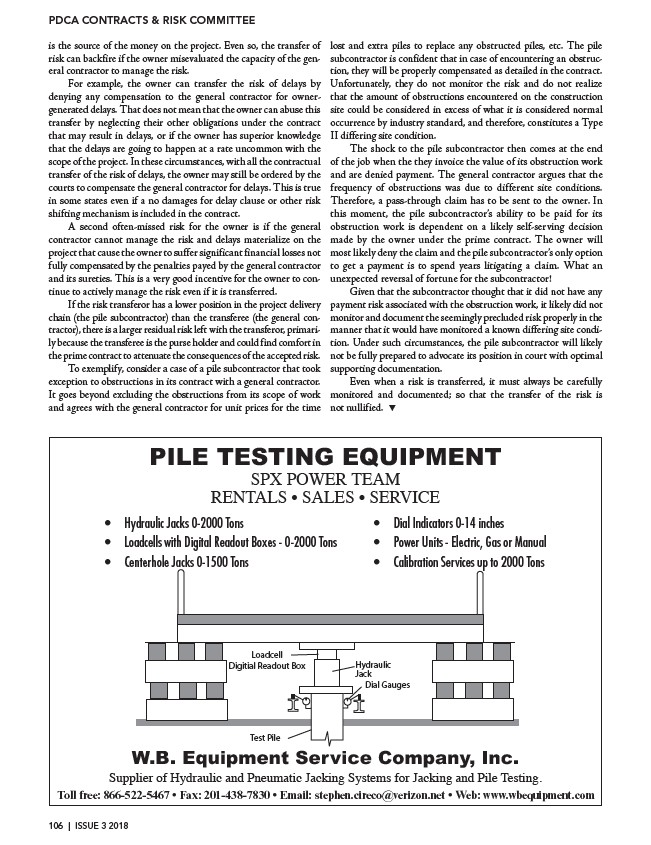
PILE TESTING EQUIPMENT
SPX POWER TEAM
RENTALS • SALES • SERVICE
Loadcell
Digitial Readout Box
Test Pile
Hydraulic
Jack
Dial Gauges
• Hydraulic Jacks 0-2000 Tons
• Loadcells with Digital Readout Boxes - 0-2000 Tons
• Centerhole Jacks 0-1500 Tons
• Dial Indicators 0-14 inches
• Power Units - Electric, Gas or Manual
• Calibration Services up to 2000 Tons
W.B. Equipment Service Company, Inc.
Supplier of Hydraulic and Pneumatic Jacking Systems for Jacking and Pile Testing.
Toll free: 866-522-5467 • Fax: 201-438-7830 • Email: stephen.cireco@verizon.net • Web: www.wbequipment.com
106 | ISSUE 3 2018
/www.wbequipment.com
link
/www.wbequipment.com
link