items. You’ve got to really understand what business they’re in, what
they’ve been doing, what their corporate culture is and how they’re
expected to expedite work out in the field. When you do that, you
get a very good picture of the risk.”
Hurting small contractors
Though the insurance industry factors in a variety of benchmarks
when considering a contractors’ safety performance and risk, a large
part of the construction industry has settled on EMR as the main
safety benchmark for bid prequalification.
“What the EMR has evolved to over time is one of the primary
lagging indicators that our clients look at when evaluating a contractor,”
said Wampol. “…Literally every time we are approaching a
client to qualify for a job to bid another project, one of the very first
questions that every client asks is, ‘What’s your EMR?’”
NCCI chief actuary Kathy Antonello says such a reliance on
EMR, also called “E-mod,” is a misuse of the rating.
“It’s not appropriate to use E-mods to compare relative safety
of employers,” Antonello said in an article on NCCI’s website.
She cites several reasons why the rating could be unfair when
used as a safety measure.
Along with putting contractors with a smaller payroll at a
disadvantage, she says, a contractor classified “at the higher end of
a broadly defined construction classification” could have a higher
EMR “because of the nature of its business.”
Also, some states allow EMR to be offset by purchasing a
deductible policy, which could allow a contractor to give the “illusion
of better experience,” she said. Contractors in those states who
don’t purchase a deductible policy or those from states that don’t
offer such deductibles could be at a disadvantage.
And some companies are not large enough to even receive an
experience rating, she says.
Efforts to move away from EMR
Despite a variety of efforts over the years to come up with safety
benchmarks beyond EMR for bid prequalification, Wampol sees
little change on the horizon for the construction industry’s overemphasis
on EMR.
“What is the metric to measure safety in our industry? …The
construction industry really can’t give a good answer to that,” he
said. “And that’s been a struggle now for years.”
Part of the problem, he says, is that construction is so diverse,
it’s difficult to pinpoint one indicator that is fair to all.
“What makes a really good commercial contractor out building
a big box retail center does not necessarily translate into somebody
working in the oil and gas industry along the Texas Gulf
Coast,” he said.
He has seen some changes in the oil and gas industry and in
heavy construction in which project owners look beyond EMR to
a company’s training programs, its management’s engagement in
safety programs or other more in-depth factors. But general construction
remains less consistent.
“I don’t see us getting any consistency in that whole prequalification
process anytime soon,” he said.
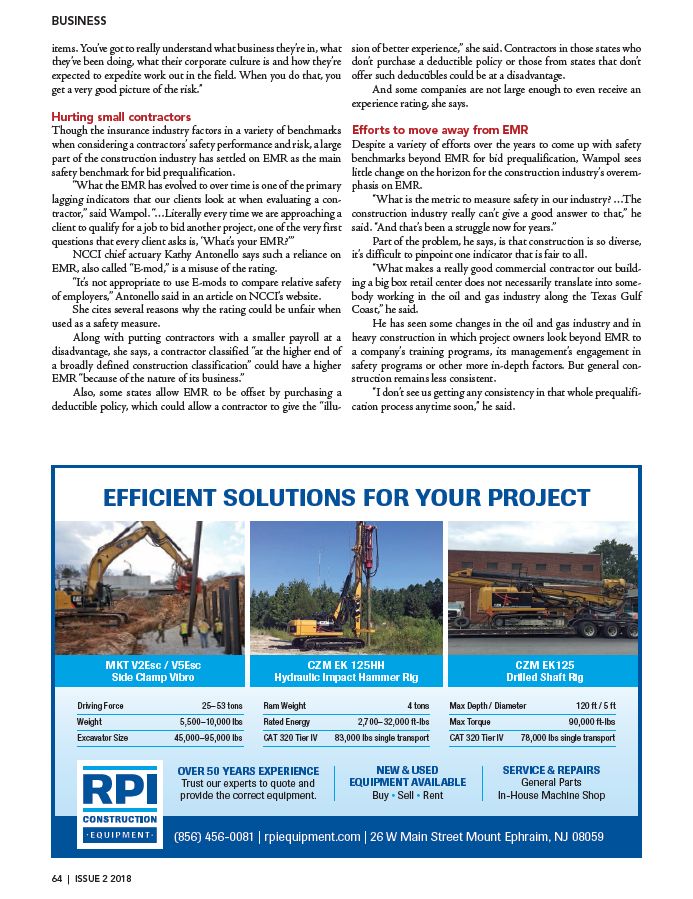
EfficiEnt SolutionS for your ProjEct
MKt V2Esc / V5Esc
Side clamp Vibro
cZM EK 125HH
Hydraulic impact Hammer rig
cZM EK125
Drilled Shaft rig
Driving Force 25–53 tons
Weight 5,500–10,000 lbs
Excavator Size 45,000–95,000 lbs
Ram Weight 4 tons
Rated Energy 2,700–32,000 ft-lbs
CAT 320 Tier IV 83,000 lbs single transport
Max Depth / Diameter 120 ft / 5 ft
Max Torque 90,000 ft-lbs
CAT 320 Tier IV 78,000 lbs single transport
oVEr 50 yEarS ExPEriEncE
Trust our experts to quote and
provide the correct equipment.
nEw & uSED
EquiPMEnt aVailablE
Buy • Sell • Rent
SErVicE & rEPairS
General Parts
In-House Machine Shop
(856) 456-0081 | rpiequipment.com | 26 W Main Street Mount Ephraim, NJ 08059
BUSINESS
64 | ISSUE 2 2018
link
/www.rpiequipment.com